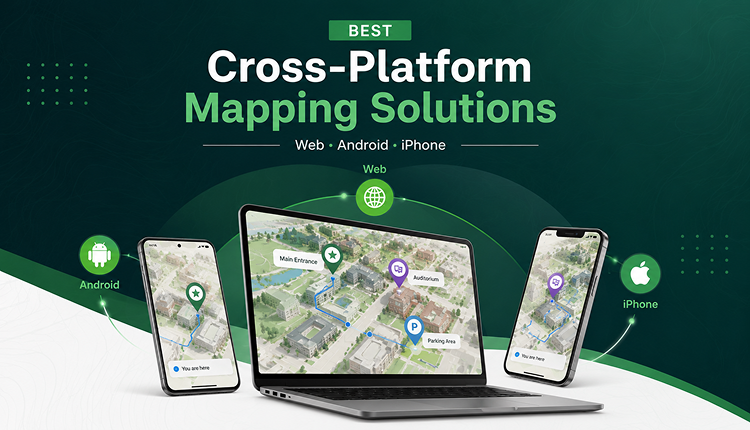
Best Cross-Platform Mapping Solutions for Web, Android, and iPhone
Discover how a single mapping solution can power interactive maps across Web, Android, and iPhone while delivering a seamless user experience.
Introduction
In today’s hyper-connected digital landscape, consumer patience for fragmented tech experiences is at an all-time low. Whether a user is planning a regional road trip, navigating a high-stakes corporate trade show, exploring a university campus, or mapping a weekend route through a theme park, they demand an uninterrupted spatial experience. They expect information to load instantly, accurately, and identically—regardless of the device in their hand.
This is where cross-platform mapping solutions have fundamentally changed the operational game.
Instead of burning engineering resources to build, test, and maintain separate codebases for native iOS apps, Android apps, and desktop web portals, forward-thinking organisations are deploying unified digital maps. With a cross-platform mapping solution, you can design a single, highly interactive spatial ecosystem that renders flawlessly across all modern browsers and operating systems and instantly synchronizes data from a single cloud-hosted backend.
What Is a Cross-Platform Mapping Solution?
At its core, a cross-platform mapping solution is an agile, cloud-synchronised digital navigation platform engineered to deliver a uniform, high-fidelity experience across multiple hardware ecosystems:
Unlike old-school blueprint uploads or static PDF files, these modern frameworks turn spatial graphics into living software networks. Users gain access to real-time location streaming, responsive searching, interactive multimedia pop-ups, and fluid route visualisation, no matter how they choose to log on.
Why Businesses Are Shifting to Unified Maps
Modern consumer journeys are rarely linear. A visitor might discover your venue on a work desktop, double-check parking rules on an iPhone while riding in an Uber, and rely on an Android tablet once on the ground.
If your spatial data is trapped in fragmented silos, information discrepancies inevitably occur. Forcing device parity yields massive operational advantages:
-
Zero-Friction Maintenance: Update a coordinate or vendor name once; deploy it everywhere simultaneously.
-
Drastically Lower Overhead: Cut software development and routine maintenance costs by consolidating three separate codebases into one.
-
Frictionless Adoption: Eliminate the "App Store Tax." Visitors can view the full map instantly via ambient web rendering without a mandatory download.
-
Unbroken User Journeys: Deliver identical branding, messaging, and navigational data at every physical and digital touchpoint.
Essential Features of Modern Cross-Platform Mapping Software
The premier mapping solutions of 2026 do far more than drop pins on a grid. Look for platforms that boast these core operational capabilities:
Rich Interactive Nodes
Every point of interest should serve as a dynamic informational landing page. When a user taps a location marker, it should trigger an optimized information panel packed with high-resolution imagery, contextual video clips, live hours of operation, contact links, and deep-linked promotions.
Instant Cloud Synchronisation
If a pathway closes due to maintenance or a vendor unexpectedly shifts booths, manual data updates are a liability. True cross-platform software pushes administrative dashboard changes to all active user devices in milliseconds, ensuring absolute field accuracy.
Frictionless QR Code Deployment
Maximise on-site utilization by placing physical QR codes on high-traffic signage, entry turnstiles, and information desks. Visitors scan the code with their native phone camera, and the complete interactive map loads in their browser instantly—no account creation or app installation required.
Predictive Index Searching
A complex space requires a powerful directory. A robust search function includes smart predictive text, deep keyword filtering, and alias tagging to route users safely to facilities, parking zones, and amenities in seconds.
Industries Capitalizing on the Cross-Platform Shift
"If a physical space requires a directory board, it requires a cross-platform digital map."
-
Events and Major Festivals: Help thousands of attendees seamlessly pivot between multi-stage programming lineups, food vendor grids, first-aid hubs, and shifting crowd zones.
-
Tourism & Heritage Sites: Transform historic city centers and museums into self-guided open-air tours complete with rich multimedia coordinates, specialized walking loops, and local neighborhood insights.
-
Higher Education: Empower incoming students, visiting parents, and new faculty to easily locate specific lecture halls, hidden libraries, student housing blocks, and administrative offices.
-
Parks & Outdoor Recreation: Keep hikers and campers safe by displaying interactive trail loops, difficulty ratings, scenic viewpoints, and real-time emergency exits.
-
Commercial Shopping Centers: Optimise the retail journey by allowing shoppers to instantly pinpoint specific stores, elevators, valet zones, and guest services.
The Hard Truth: Interactive vs. Static Maps
| Operational Capability | Modern Cross-Platform Apps | Legacy PDF Map Files | Printed Paper Directories |
|---|---|---|---|
| Instant Data Sync | Yes, instant server-side push | No, requires complete file overwrite | No, requires total reprinting |
| Mobile Readability | Responsive layout scaling | Frustrating manual pinching | Clunky, un-illuminated print |
| Directory Search | Predictive keyword lookup | Manual visual scanning only | Manual page-by-page tracking |
| Multimedia Depth | Embedded photo/video panels | Zero, flat text strings only | Zero, static imagery only |
| Maintenance Expenses | Minimal, flat software scale | Ongoing graphic export fees | Extreme re-printing overhead |
Selecting the Right Solution for Your Venue
Before signing a contract with a digital wayfinding vendor, protect your tech investment by asking your team these critical framework questions:
-
Is it truly device-agnostic? Does the user interface render with identical speed and graphic precision across Chrome, Safari, Android, and iOS?
-
How steep is the administrative learning curve? Can your field staff easily update text, change paths, and adjust markers without needing a background in software engineering?
-
Does it support web-based QR launching? Can you bypass app stores entirely to guarantee maximum visitor adoption?
-
Can it scale seamlessly? As your properties expand, can the platform easily support multi-venue architecture under one master account?
Platforms like emapX Live are engineered specifically to hit these precise standards, serving as an all-in-one ecosystem that completely phases out outdated venue PDFs in favor of dynamic, brand-aligned, accessible spatial intelligence.
Final Thoughts
Cross-platform mapping has evolved from a progressive marketing asset into a foundation of venue operations. By deploying a singular, dynamic map that bridges the gap between Web, Android, and iPhone, your organization can simultaneously eliminate logistical friction, skyrocket audience engagement, and wipe out heavy printing budgets.
As the digital demands of consumers continue to accelerate, keeping your physical space accessible, searchable, and connected isn't just a smart business decision—it's the only way to future-proof your brand.
What kind of physical footprint is your team managing, and how much time do you currently spend manually updating your various maps and directories?
